


 My Profile
 My Pets
 My Address
 My Orders
 Coupons
 Refer & Earn
 Log Out
When to Consult an Online Vet? 10 Common Pet Problems You Can Solve Instantly

Written by ThePetNest Editorial Team | Medically Reviewed by Dr. Vikas Mahajan, MVSc (VCI Reg. No. VCI-MH-2019-10043 — 6 years of clinical practice in small animal medicine, Pune)
It's 11:30 at night. Your Labrador is scratching his ear raw, shaking his head every few minutes, and you can tell something's off. The nearest vet clinic closed hours ago. You're not sure if this is a “wait till morning” situation or a “drive to an emergency clinic” one.
This is exactly the moment online vet consultations were built for.
Quick Verdict — Read This First
Is your pet breathing normally and alert? Start with an online consultation.
Is your pet collapsing, seizing, bleeding heavily, or struggling to breathe? Stop reading. Go to a clinic right now. The rest of this guide will be here when you're back.
Before You Scroll: Emergency Red Flags
Get to a physical vet immediately — do not wait, do not call online — if your pet shows any of the following:
- High fever (above 104°F / 40°C) or shivering with a cold body
- Continuous vomiting — more than three times in a few hours, especially with blood
- Heavy bleeding that doesn't stop within two to three minutes of steady pressure
- Difficulty breathing — open-mouth breathing in cats is always a critical emergency
- Suspected fracture or total inability to bear weight after a fall
- Collapse, seizures, or sudden loss of coordination
- Suspected poisoning — rat poison, human medications, toxic plants like Dieffenbachia or Oleander
- Bloated, hard abdomen in large-breed dogs — this can be life-threatening GDV (gastric dilatation-volvulus)
Rush to a physical vet immediately. No platform, however well-staffed, can examine, X-ray, or stabilise a critically ill animal through a screen.
If none of the above apply, read on. You're likely dealing with something an online vet can genuinely help you navigate.
What Is an Online Vet Consultation?
An online vet consultation — also called telemedicine for pets — is a video, voice, or chat-based session with a licensed veterinarian conducted remotely through a platform like ThePetNest's Online Vet Consultation Services. Think of it as a video call with a vet: you share your pet's symptoms, show them a short clip if helpful, and get structured clinical guidance within minutes.
You describe your pet's symptoms, share photos or a short video clip, and the vet guides you through what's likely happening, what you can do at home, and whether a physical visit is actually needed. In the majority of non-emergency cases, that structured guidance is all you need.
What it is not: a replacement for surgery, physical examination, diagnostic blood work, or emergency trauma care. Any vet worth their degree will tell you this upfront, and the good ones draw that line clearly.
India's Pet Care Reality in 2026
India's overall pet population grew approximately 5% in 2024, with a similar rate anticipated in 2025, reaching 39 million pets. There are expected to be 43 million pet dogs alone by 2026, with the pet services sector projected to reach $0.5 billion. India's pet care industry is projected to reach ₹2.1 trillion by 2032 at a 20% CAGR, with 30 million pets in urban households alone.
And yet, access to qualified veterinary care has not kept pace. India has fewer than 65,000 registered veterinarians for a pet population that size — a ratio that leaves most urban pet parents severely underserved, especially outside clinic hours.
Online vet consultations have stepped in to fill that gap. Cities like Pune, Mumbai, Bangalore, and Hyderabad are leading adoption, partly because of pet population density and partly because of a young, digitally-native pet parent base that expects the same on-demand access for their pets that they get for everything else in their lives.
Signs Your Pet Needs Instant Online Vet Help
Before we get into specific problems, here's a general rule. If your pet is showing any of the following, an online consultation is a smart, immediate first step:
Sudden behavioural changes — a playful dog who's gone quiet, a cat hiding more than usual, uncharacteristic aggression. Pets signal discomfort behaviourally before physical symptoms are visible.
Loss of appetite for more than 12–18 hours — especially critical in cats, where skipping meals can escalate to hepatic lipidosis (fatty liver disease) far faster than most owners realise.
Skin or coat changes — patches of hair loss, redness, excessive scratching, or a coat that has lost its sheen over the last few days.
Minor injuries — small cuts, mild limping, or a scrape you're not sure needs stitching.
The 10 Pet Problems You Can Solve Instantly with an Online Vet
Jump To
- Mild Vomiting and Upset Stomach
- Diarrhoea or Loose Motions
- Ticks, Fleas and Skin Irritation
- Ear Itching or Head Shaking
- Mild Allergies
- Red Eyes or Eye Discharge
- Minor Cuts, Scratches and Injuries
- Coughing, Sneezing or Cold-Like Symptoms
- Loss of Appetite in Cats (Act at 12–18 Hours)
- Anxiety, Stress and Behavioural Issues
1 Mild Vomiting and Upset Stomach
Dogs vomit. A lot. Sometimes it's because they ate grass, scarfed their food too fast, or found something unpleasant during their morning walk. One or two isolated episodes of vomiting, in a pet who is otherwise alert, drinking water, and not in obvious pain, is usually not an emergency.
An online vet will help you differentiate between dietary indiscretion — the clinical term for “your dog ate something it shouldn't have” — and something that warrants closer monitoring. They'll typically guide you through a 12–24 hour bland diet and tell you exactly which signs should send you to a clinic: blood in the vomit, more than three episodes in a day, or progressive lethargy.
Vet Insight from ThePetNest
In our experience with Indian breeds and mixed-breeds, adding one teaspoon of plain, unsweetened curd to boiled rice during the bland diet phase works well as a natural probiotic. Many Indian dogs — especially those that eat home-cooked food regularly — respond well to this approach. Always confirm with your online vet first, particularly if your dog is lactose sensitive.
2 Diarrhoea or Loose Motions
Loose stools are one of the top reasons pet parents call vets in Indian cities. The cause is almost always benign — a sudden switch in food, stress, street food scavenged on a walk, or sensitivity to a new treat. But diarrhoea dehydrates pets quickly, and in puppies or kittens under six months, even 18 hours of it can become serious.
An online vet will assess frequency, stool consistency, and whether there's blood or mucus involved. They can recommend oral rehydration and dietary adjustments immediately and tell you if the situation warrants a stool culture or physical exam.
Localisation Note — Mumbai Monsoons
During Mumbai monsoons, the risk of Leptospirosis — a bacterial infection spread through water contaminated by rat urine — spikes sharply. Dogs that walk through flooded streets or puddles and subsequently develop diarrhoea, fever, or jaundice need a physical vet visit, not just a telemedicine call. An online vet can flag this risk immediately if you mention your location and recent weather exposure.
3 Ticks, Fleas and Skin Irritation
In Indian cities, especially during and after the monsoon, tick and flea infestations are extremely common. Dense-coated breeds — Huskies, Golden Retrievers, Shih Tzus, Lhasa Apsos — are particularly prone. Tick-borne diseases, including Babesiosis and Ehrlichiosis, remain among the most underdiagnosed conditions in urban Indian pet dogs.
An online vet can examine your pet's coat via video, identify whether you're dealing with ticks, fleas, mites, or contact dermatitis, and recommend specific prescription-grade or OTC products by name. They can also walk you through safe tick removal — twisting incorrectly and leaving the head embedded is a very common mistake that leads to secondary infection.
For grooming-related skin care between vet visits, our Ultimate Guide to Pet Grooming in India covers prevention and coat maintenance in detail.
Localisation Note — North India Construction Zones
In North Indian cities like Delhi, Gurgaon, and Noida — where construction dust is near-constant — we see a high incidence of contact dermatitis on paw pads from alkaline debris. If your dog is licking their paws obsessively after walks through construction zones, rinse their paws with clean water immediately after every outing. An online vet can confirm whether you need a medicated soak or an antifungal.
4 Ear Itching or Head Shaking
If your dog is scratching one ear and shaking their head repeatedly, it's almost certainly ear-related. The question an online vet helps you answer is: what's causing it? Wax buildup, a trapped grass seed, an early-stage yeast infection, or ear mites all present similarly but need different treatment.
A vet on a video call will ask the right diagnostic questions: Is there a smell? Is the skin inside the ear red or inflamed? Is there a dark discharge? Based on your answers, they can often differentiate between something manageable at home versus an infection that needs prescription ear drops — and guide you on proper cleaning technique to avoid pushing debris deeper into the ear canal.
5 Mild Allergies
Allergies in Indian pets are increasing, driven by changing diets (more ultra-processed food) and urban environmental factors — construction dust, seasonal pollen, certain indoor plants. They typically present as red itchy skin, paw licking, watery eyes, recurring sneezing, or a rash on the belly.
An online vet can help you map patterns: Does it flare after a walk? After a specific meal? During a particular season? That diagnostic conversation — history-taking and pattern recognition — is something a well-structured video call handles quite effectively.
Localisation Note — Hyderabad & Pune
In Hyderabad and Pune, Parthenium (Congress grass), an invasive weed that peaks between August and November, is a documented allergen for dogs with sensitive skin. If your pet's itching spikes post-monsoon and they've been in open grounds or parks, mention this specifically to your online vet. It changes the treatment approach entirely.
6 Red Eyes or Eye Discharge
Redness, discharge, or excessive blinking in your pet's eye can look alarming but is frequently benign — mild conjunctivitis, a dust particle, or a blocked tear duct. An online vet can guide you through basic first aid: a gentle saline rinse, keeping the area clean, and the specific signs that indicate something more serious — a corneal scratch, uveitis, or cherry eye — that needs in-person attention.
When to escalate immediately: If the eyeball itself looks cloudy, the eye is held completely shut, or your pet is pawing at their eye in pain, don't wait. This could be a corneal ulcer that worsens rapidly without treatment.
7 Minor Cuts, Scratches and Injuries
Small wounds from rough play, a run-in with a thorny plant, or a scrape on concrete can almost always be assessed and managed at home with the right guidance. An online vet can look at the wound via video, assess its depth and edges, guide you through cleaning and bandaging, and tell you clearly if the cut looks deep enough to need stitching.
This is one of the most practical applications of pet telemedicine — expert eyes on the injury without the added stress of transporting an already anxious, hurting animal. For home first aid essentials, our Pet Grooming at Home guide includes a basic wound care kit checklist worth keeping handy.
8 Coughing, Sneezing or Cold-Like Symptoms
Dogs and cats get upper respiratory infections, just like we do. In cats, herpesvirus and calicivirus are the two most common culprits — causing sneezing, nasal discharge, and mild lethargy. In dogs, kennel cough (infectious tracheobronchitis) is a frequent post-boarding or post-park visit complaint, especially in cities with a dense dog park culture.
An online vet can assess symptom severity, determine whether you need supportive home care or prescription antivirals, and advise on isolation protocols if you have multiple pets at home.
9 Loss of Appetite in Cats (Act at 12–18 Hours)
Dogs can be picky eaters and occasionally skip a meal without immediate concern. Cats are a different matter entirely. Going without food for more than 12–18 hours puts cats at meaningful risk of hepatic lipidosis — fatty liver disease — because of how uniquely their metabolism functions. Unlike dogs, a cat's liver begins processing stored fat for energy very quickly, and once this cascade starts, it becomes significantly harder to reverse.
Do not wait for the 24-hour mark. If your cat has not eaten for 12–18 hours, that is the window to place a video call with a vet — not to observe for another day.
An online vet will ask about water intake, recent activity level, any environmental changes, recent vaccinations, and whether there has been any vomiting. In most cases they'll identify a likely cause and give you a clear next step — which may well include “come in now.”
Vet Insight from ThePetNest
In our clinical experience, appetite loss in cats is frequently triggered by stress from household changes — a new person, a renovation, even rearranged furniture. Cats are exquisitely sensitive to environmental disruption in a way dogs are not. Always mention any recent changes in your home during the telemedicine call, even if they seem trivial.
10 Anxiety, Stress and Behavioural Issues
This is the most underutilised reason to use an online vet — and one of the most impactful. Separation anxiety is at near-epidemic levels in Indian cities, largely because pets raised during 2020–2022's work-from-home years are now alone for eight-plus hours daily. Sudden aggression, destructive chewing, excessive barking, regression in toilet training, and compulsive behaviours are all things a vet — often working alongside a certified animal behaviourist — can begin addressing through a structured consultation.
A video call with a vet is, in many ways, ideal for behavioural concerns. The vet can observe how you interact with your pet, assess the home environment visible on camera, and tailor recommendations to what they actually see rather than what you describe.
Vet Insight from ThePetNest
Behavioural consultations are almost always multi-session. The first call is about ruling out medical causes — pain, hypothyroidism, neurological issues — that can mimic behavioural problems. Don't be surprised if your online vet recommends blood work before prescribing a behaviour modification plan.
Online Consultation vs. Emergency Clinic — At a Glance
Scroll horizontally on mobile to view full table.
| Symptom | Online Action | Go to Clinic If… |
|---|---|---|
| Vomiting (1–2 times) | Assess frequency, guide bland diet | More than 3 times, blood present, lethargy |
| Loose stools | Rehydration advice, dietary adjustment | Blood or mucus in stool, puppy/kitten under 6 months |
| Ear scratching / head shaking | Video check for mites, wax, or early infection | Ear canal swollen shut, bleeding, strong odour |
| Skin itching / rashes | Identify allergen or parasite, recommend product | Open sores, hair loss in large patches, fever |
| Eye redness / discharge | Saline rinse guidance, monitor | Cloudy eyeball, eye held shut, pawing in pain |
| Minor cut or scrape | Wound assessment, bandaging guidance | Won't stop bleeding, wound edges are gaping |
| Coughing / sneezing | Symptom severity check, home care plan | Laboured breathing, blue gums, refusal to eat |
| Loss of appetite — cat | Act at 12–18 hours, video call immediately | Vomiting also present, severe lethargy, yellow tinge to skin |
| Loss of appetite — dog | Identify cause, monitor water intake | Not eating for 48+ hours, vomiting also present |
| Mild anxiety / stress | Behaviour history, rule out medical cause | Self-harm, sudden unprovoked aggression, seizure-like episodes |
| Tick or flea infestation | Product recommendation, removal guidance | Fever, pale gums, jaundice after tick exposure |
Benefits of Online Vet Consultations
Immediate Access
Most platforms connect you within minutes, around the clock. At 2 AM when your cat is acting strangely, that matters.
Affordability
A typical online vet session in India costs ₹200–₹600, compared to ₹800–₹2,500 or more for a clinic visit with waiting time factored in.
Second Opinions
After a diagnosis or treatment plan, many pet parents use a video call with a vet to sanity-check what they've been told. Good vets actively encourage this.
Reduced Stress for Your Pet
For animals with clinic anxiety — extremely common in both dogs and cats — a home consultation removes the trigger entirely. Less cortisol, better cooperation, more accurate symptom presentation.
Night & Weekend Coverage
Most Indian cities have very few genuine 24-hour emergency clinics. Online vets fill that gap with triage guidance that helps you make smarter decisions until a clinic opens.
Why Online Vet Services Are Growing in India's Major Cities
India's overall pet population is expected to reach 39 million in 2025, and there are expected to be 43 million pet dogs alone by 2026. Bangalore, Mumbai, Pune, and Hyderabad account for a significant share of this growth — driven by young professionals, nuclear households, and rising disposable incomes.
What all four cities also share: traffic, time pressure, and a pet-owning population that is digitally comfortable and demanding of convenience in a way no previous generation of Indian pet parents was.
A drive to the vet in Koramangala on a weekday evening or across the Bandra-Worli corridor isn't a 20-minute errand — it's a two-hour ordeal that can be genuinely distressing for a nervous animal. For the majority of common, non-emergency problems, pet telemedicine removes that friction entirely.
The infrastructure is also maturing rapidly. Better video quality, platforms with stored medical records, and licensed professionals who understand Indian breeds, Indian diets, and India-specific disease patterns — from leptospirosis in flood-prone cities to heat-related illness in North Indian summers — are what separate a credible online consultation from a generic advice line.
People Also Ask
What problems can an online vet solve immediately?
Mild vomiting, diarrhoea, skin irritation, tick or flea issues, ear problems, minor cuts, cold-like symptoms, eye discharge, early loss of appetite, and anxiety or behavioural concerns can all be assessed and guided via pet telemedicine by a qualified vet.
Is online vet consultation reliable in India?
Yes — when you use a platform with licensed, registered veterinarians. Always confirm credentials before a session. Reputable platforms list their vets' VCI registration numbers and qualifications prominently.
How much does an online vet appointment cost in India?
Typically between ₹200 and ₹600 per session depending on the platform and duration. Some platforms offer subscription plans for families with multiple pets or frequent follow-up needs.
Can I consult a vet online for vomiting?
Yes — for mild or isolated vomiting, an online consultation is very effective. If vomiting is frequent, severe, or contains blood, go to a clinic immediately.
Is online vet advice enough for skin problems?
For most common skin issues — ticks, mild allergies, early-stage dermatitis — online consultations are sufficient for initial guidance. Deep infections, wounds, or undiagnosed lumps must be examined physically.
Should I consult a vet online or offline for diarrhoea?
Start online if your pet is alert, drinking water, and has had fewer than three to four loose stools. If there's blood in the stool, severe lethargy, or your pet is very young, go in person immediately.
Can I get cat-specific online vet guidance?
Absolutely. Cats have very different physiology and disease patterns than dogs — from their hepatic lipidosis risk at just 12–18 hours without food to unique respiratory viruses. A good online vet platform will have vets experienced specifically in feline medicine.
Are online vets available 24/7 in India?
Several platforms offer round-the-clock availability. ThePetNest's Online Vet Consultation Services connects you with qualified vets at any hour — exactly when you need them most.
The best thing about online vet consultations isn't that they replace physical care. It's that they help you figure out, fast, whether physical care is what your pet actually needs right now — or whether you can breathe, follow a home care plan, and monitor quietly through the night.
That clarity alone is worth a lot at 11:30 PM when your dog won't stop scratching his ear.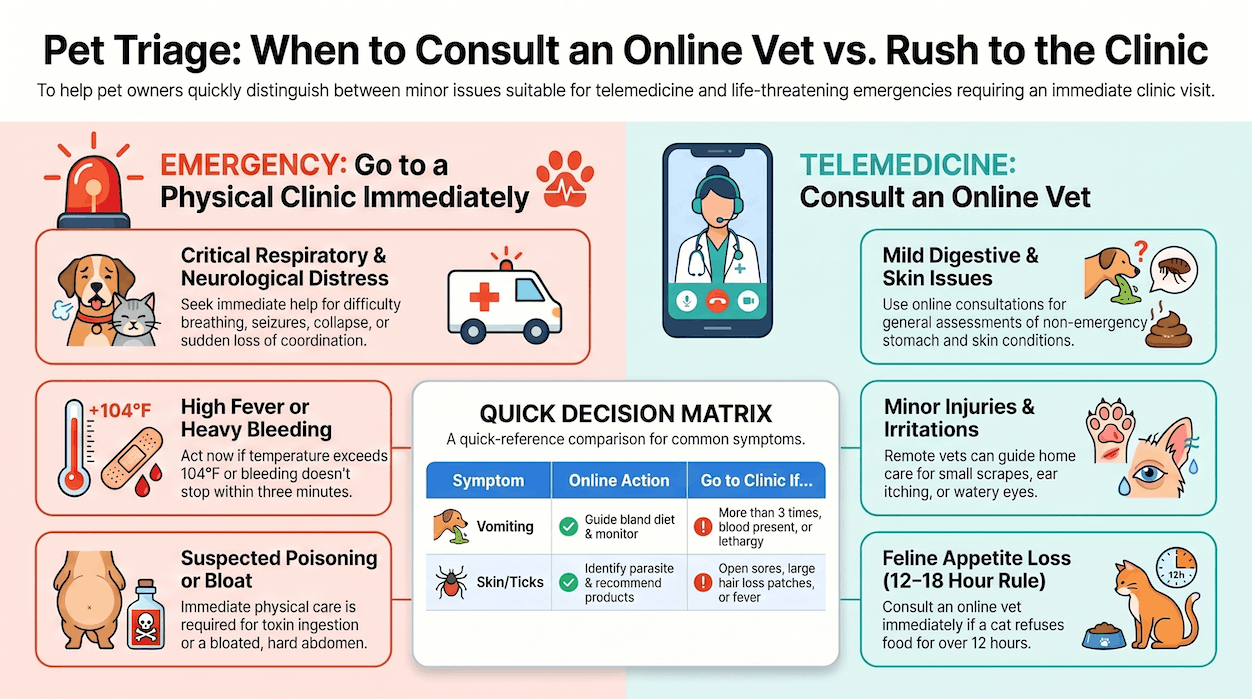
Medically Reviewed By
Dr. Vikas Mahajan, MVSc
VCI Registration No. VCI-MH-2019-10043 • 6 years of clinical practice in small animal medicine • Pune, Maharashtra
Last reviewed: April 2026
New Comment