


 My Profile
 My Pets
 My Address
 My Orders
 Coupons
 Refer & Earn
 Log Out
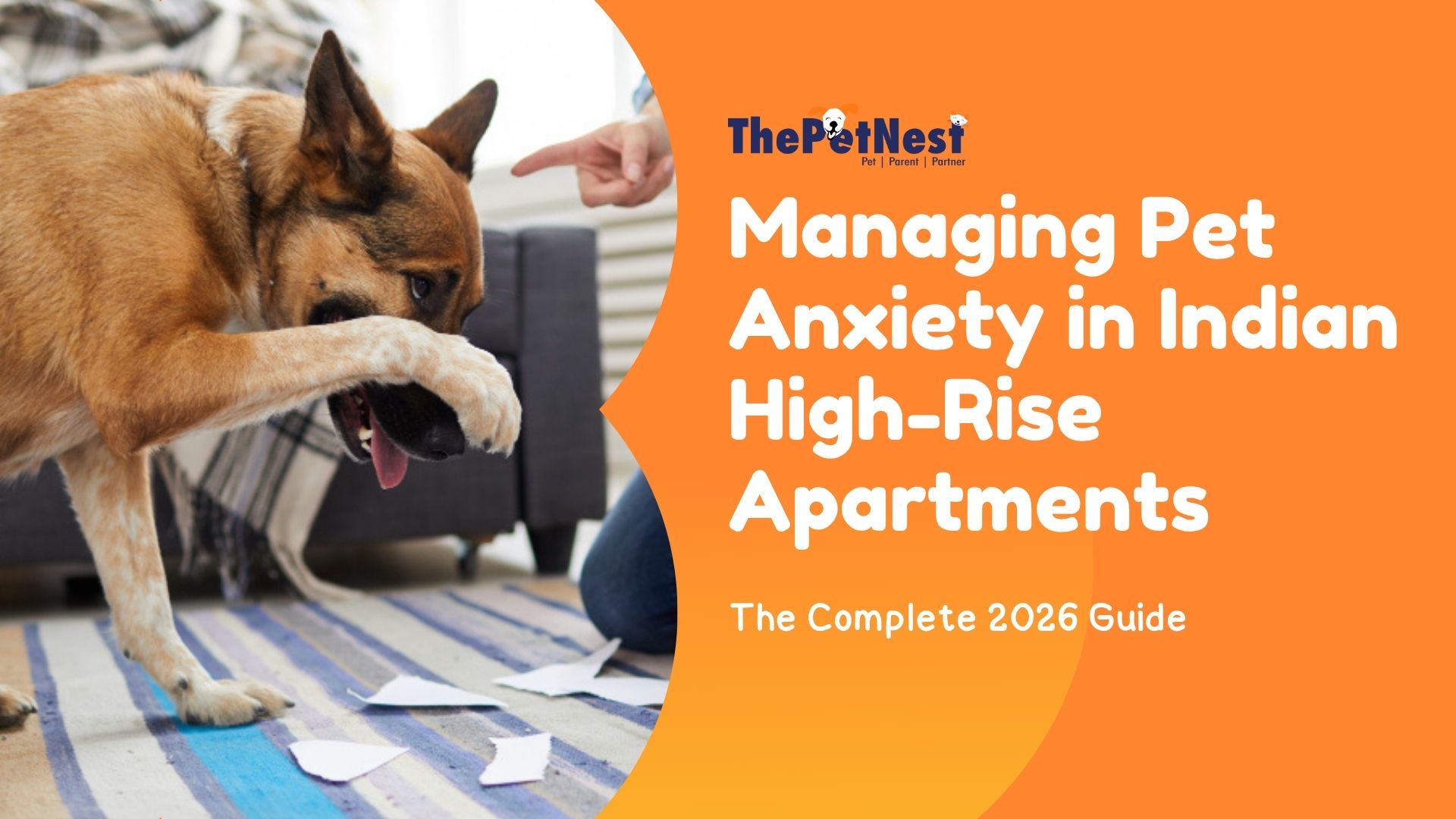
The Ultimate Guide to Managing Pet Anxiety in Indian High-Rise Apartments (2026 Edition)
By ThePetNest Editorial Team · 12 min read
It's 9 AM in Sector 54, Gurgaon. The lift chimes on your floor. Your Labrador goes from zero to full panic in under two seconds — claws on marble, tail down, ears flat. You haven't even opened the door yet.
If this sounds like a Tuesday morning in your home, you are not alone — and your dog is not "poorly trained." What you're witnessing is a fundamentally modern problem: an animal built for open fields and pack dynamics, squeezed into the 17th floor of a gated society, navigating lift chimes, delivery doorbells, unfamiliar smells from 120 other households, and an owner who is herself running on three hours of sleep and back-to-back Zoom calls.
India's pet industry is one of the fastest-growing in Asia, growing at over 10% CAGR through 2026, driven almost entirely by urban adoption. Cats and apartment-friendly small breeds — Shih Tzus, Beagles, Indie mixes — are the fastest-growing segment within that boom. But nobody talks about what happens after the puppy comes home and figures out that "the park" is a 400-square-foot patch of RCC surrounded by parked SUVs.
This guide is for exactly that moment. We'll break down why high-rise living is a legitimate anxiety trigger, how to spot it early in your dog or cat, what your legal rights actually are as a pet owner in a CHS or gated community, and — most importantly — what actually works to make apartment life work for your pet.
Why High-Rises Are Genuinely Stressful for Pets
We tend to frame apartment-pet anxiety as a training problem. It isn't — at least not entirely. Before we talk solutions, it's worth understanding why the environment itself is designed, quite unintentionally, to overwhelm a dog or cat's nervous system.
The "Sound Canyon" Problem
A dog's hearing range extends up to 65,000 Hz — roughly four times that of a human. In a high-rise corridor, that means every lift chime, every neighbour's TV, every child on a different floor, every AC compressor on the terrace registers with startling clarity. Concrete corridors amplify and echo sound rather than absorbing it. What sounds like "background noise" to you arrives at your pet like a barrage of unpredictable stimuli — all day, every day, with no way to escape or investigate the source.
Research consistently shows that unpredictable, uncontrollable sound is significantly more stressful than predictable loud noise. The lift your dog can't see — arriving at random intervals with unknown passengers — is neurologically worse than a constant loud sound.
The 30-Second Lift Problem
Think about what happens during a typical lift ride: your dog is in a confined metal box, inches from a stranger or another dog, unable to move laterally, unable to retreat, unable to sniff and investigate the other party properly. Dogs use a complex body-language vocabulary — approach angles, sniff sequences, weight shifting — to communicate safety and intent. The lift eliminates all of it. The result is what animal behaviourists call a "high-stress forced encounter": all the physical proximity of social interaction, none of the communicative tools to navigate it.
Do this twice a day for years, and you have a dog that associates going outside — the thing they most want — with a prior experience that's reliably stressful. This is how apartment dogs develop leash reactivity and gate anxiety without ever having been "through" anything traumatic in the conventional sense.
Social Deprivation Disguised as Socialisation
The "society park meeting" is perhaps the most widely misunderstood concept in urban Indian pet ownership. Many owners believe their dog is well-socialised because it interacts with other dogs in the compound every morning. But brief, managed, leashed encounters in an unfamiliar shared space are not socialisation — they're controlled proximity. Without the freedom to approach, disengage, chase, and play on their own terms, dogs in these meetings often build quiet tension rather than bond. Over time this contributes to reactivity and social anxiety rather than alleviating it.
Mirroring Your Stress
Here's the uncomfortable part: your cortisol levels matter. Studies in human-animal bond research have repeatedly documented that pets — especially dogs — physiologically synchronise with their owners' stress hormones. India's urban professionals consistently rank among the most work-stressed demographic groups in Asia-Pacific surveys. If you're fielding client escalations from 9 PM to midnight, your dog is lying next to you while that stress floods the room. They absorb it. And unlike you, they can't rationalise it away or scroll Instagram to decompress.
Apartment anxiety isn't primarily a behaviour problem — it's an environment-mismatch problem. Understanding this shifts the response from "discipline" to "design." You're not fixing a broken pet; you're redesigning a broken environment.
How to Actually Tell If Your Pet Has Anxiety
This is where most pet parents get lost. Anxiety in apartment pets rarely looks like the dramatic whimpering and shaking you might picture. More often it's quiet, cumulative, and easily explained away as "just their personality."
Signs in Cats
- Over-grooming or bald patches
- Hiding behind the washing machine
- Litter box avoidance or inconsistency
- Reduced appetite over multiple days
- Excessive vocalisation at night
- Aggression when touched in familiar ways
Signs in Dogs
- Howling or barking when you leave
- Destructive behaviour near the front door
- Panting despite AC being on
- Hyper-vigilance: fixed stare at the door
- Tail low, slow movement (pessimistic posture)
- Refusing food when left alone
Separation-related problems (SRPs) — howling, destructiveness, and elimination when left alone — are among the most common reasons urban Indian pet parents seek professional help. What makes this particularly hard to catch: many dogs with separation anxiety are completely fine when you're home. The anxiety is behavioural, not temperamental — which means it's entirely learnable, and entirely un-learnable with the right approach.
For cats, hiding behaviour is the single biggest early warning sign that gets dismissed. "She's just shy" often means "she has no place in this flat where she genuinely feels safe." If your cat's consistent retreat is the dark narrow space behind the washing machine or inside a cabinet, that's not a personality quirk — that's a coping mechanism.
Your Legal Rights as a Pet Owner in Indian Housing Societies
Before we get to management strategies, this section deserves its own space — because a significant source of anxiety for pet parents in India (which subsequently affects their pets) is the constant fear of society politics, RWA bans, and neighbour complaints.
- No housing society can ban pets based on breed or size. The Animal Welfare Board of India (AWBI) has explicitly clarified this. A blanket "no pets" or "no large dogs" rule in a registered society is legally unenforceable.
- Banning pets from lifts is legally questionable. Under the Prevention of Cruelty to Animals Act, 1960, denying an animal the basic means to access their home — including using the lift — can be challenged. Several High Courts have ruled in favour of pet owners on exactly this issue.
- RWA by-laws cannot override central law. If a society committee passes a resolution against pets, it can be challenged at the District Animal Welfare Officer level, and increasingly through consumer forums and High Court petitions.
- Recent 2025–26 High Court rulings in Maharashtra and Delhi have reinforced pet owners' rights in gated communities, including the right to use common areas like gardens and walkways.
Practical advice: keep a printed copy of the AWBI guidelines and the relevant sections of the PCA Act in your flat. If your RWA sends a written notice, respond in writing — this creates a paper trail.
The Management Toolkit: What Actually Works
Everything that follows is grounded in behavioural science, not folklore. Some of these are counterintuitive — because a lot of what we instinctively do to comfort anxious pets (extra cuddles when they whine, keeping them by us constantly) can inadvertently reinforce the anxiety rather than resolve it.
Desensitise to "Apartment Sounds" Systematically
Use your Google Home, Alexa, or Spotify to play low-level urban soundscapes — lift chimes, corridor echoes, traffic sounds — during calm, positive moments at home. Start at low volume while your pet eats or plays. Gradually increase over weeks. The goal is to break the association between those sounds and the spike of alertness. White noise machines (available on Amazon India for ₹1,200–2,500) placed near the front door can significantly reduce the startle effect of corridor sounds. This is called systematic desensitisation, and it is the most evidence-backed approach to sound-triggered anxiety.
Create a Genuine Safe Zone — Not Just a Bed
This is different from putting a cushion in the corner. A proper "den" has four walls (or at least three sides), is tucked away from the main movement areas of the flat, and smells consistently of your pet. Pheromone diffusers are now widely available in India — Feliway for cats (₹1,800–2,400 at most pet stores) and Adaptil for dogs (₹2,000–2,800) release synthetic calming hormones that mimic what nursing mothers emit. They won't "fix" anxiety, but they significantly lower baseline arousal, giving behavioural training a much better chance of taking hold. Plug one in near the den, not in the middle of the living room.
Rethink Exercise — It's Not Just About Distance
A 15-minute walk in a crowded society compound is not sufficient mental stimulation for most dogs. Physical exhaustion and mental exhaustion are different things — and for anxiety specifically, mental fatigue is what you're after. Indoor scent work is extraordinarily effective: hide kibble or small treats around the flat and let your dog "hunt" them before meals. Lick mats — silicone mats with grooves you fill with peanut butter or curd, available for ₹300–600 online — engage the parasympathetic nervous system through repetitive licking, genuinely calming the animal. Puzzle feeders, snuffle mats, Kong toys stuffed with homemade treats — none of this costs much, and all of it works.
Look at the Bowl
The gut-brain connection in dogs and cats is not pseudoscience — it is increasingly mainstream in veterinary nutritional research. Gut dysbiosis (an imbalance of gut bacteria, often caused by low-quality processed food) has been linked to anxiety-like behaviours in animals. The rise of hypoallergenic and novel-protein pet foods — including insect-protein based foods, projecting toward a $1.5 billion global market by end of 2026 — is partly driven by this understanding. If your pet shows anxiety symptoms alongside loose stools or inconsistent appetite, a vet-guided dietary switch may be the most under-tried intervention available to you. Indian brands like Drools, Signature, and newer premium entrants now offer limited-ingredient and gut-health-focused formulations without the ₹8,000/month import bill.
When to Call for Help — and Who to Call
There's a specific threshold you should watch for: if your dog's separation-related behaviours — howling, destruction, elimination — are happening consistently every time you leave, and have been happening for more than three to four weeks, that's the moment for a professional, not another YouTube tutorial.
Separation anxiety is the second most common reason urban Indian pet parents seek professional behavioural help. The first is aggression. Both respond well to positive reinforcement-based training, but they respond poorly to correction-based methods — which unfortunately are still the default recommendation from many old-school trainers in Indian cities. The simplest filter when evaluating a trainer: if they use choke chains, prong collars, or recommend any form of physical correction for an anxious dog, walk away.
Technology That Actually Helps
Pet cameras like Furbo (₹9,000–12,000) and Petcube (₹7,500–10,000) allow real-time video monitoring, two-way audio, and even treat dispensing from your phone. For working professionals in Bangalore's tech corridors or Cyber City, Gurugram — where 10-hour office days are the norm — being able to check in on your dog at 2 PM and speak through the camera has a measurable calming effect on dogs with mild separation anxiety. It won't replace a trainer, but it will tell you exactly how your dog behaves when you're gone, which is invaluable diagnostic information.
Medical Support: The Honest Picture
CBD oils and calming supplements have proliferated on Indian e-commerce platforms. For mild-to-moderate situational anxiety — Diwali fireworks, specific vet visits — some products combining L-theanine, melatonin, and chamomile have reasonable evidence behind them. For chronic structural anxiety, they are adjuncts at best. Always loop in a vet before starting any supplement. For severe separation anxiety, short-term pharmacological intervention alongside a structured behaviour modification programme is the most effective and humane approach — and it works faster than most people expect.
Building a Life Worth Living — on the 17th Floor
High-rise living is not going away. By 2030, India will be home to an estimated 600 million urban residents, the majority of them in apartment complexes. The pets living alongside them are not a problem to be managed — they are a metric of how well we're designing urban life itself.
The shift we're advocating for isn't just from "anxious pet" to "calm pet." It's from managing behaviour to enriching a life. An animal that is mentally stimulated, physically active, socially confident, and gut-healthy isn't just better-behaved — it's fundamentally happier. And if you've lived with a happy dog or a genuinely relaxed cat, you know the quality of life that radiates from that into every corner of a small flat.
Your high-rise doesn't have to be a pressure cooker. With the right environment design, the right professional support when needed, and a clear understanding of your legal rights, it can be the most pet-friendly address in the city.
Your Pet Deserves Expert Support
Consult a vet online from your flat, or book a certified groomer in your city — no society politics involved.
New Comment